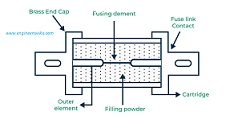
Difference between HRC fuses and Semiconductor fuses

HRC and semiconductor fuses

HRC fuses (High Rupturing Capacity fuses) and semiconductor fuses are both used for overcurrent protection but serve different applications and have distinct characteristics. Here’s a breakdown of their differences: HRC Fuses Semiconductor Fuses When choosing …

Read more

Field Programmable Logic Array

A Field Programmable Logic Array (FPLA) is a type of programmable logic device that combines the features of a Programmable Logic Array (PLA) and a Programmable Array Logic (PAL). It provides a flexible approach to …

Read more

Programmable Logic Devices

Programmable Logic Devices (PLDs) are digital electronic devices that can be programmed to perform various logic functions. They are widely used in digital circuit design and implementation, offering flexibility and customization compared to traditional fixed-function …

Read more

Multiplexed Display in Digital Electronics

A multiplexed display in digital electronics refers to a technique used to drive multiple display elements, such as LEDs or segment displays, using a smaller number of control signals or connections. It allows for the …

Read more

Counters in Digital Electronics

Counters in digital electronics are sequential logic circuits that generate a sequence of binary numbers in a specific order. They are widely used in various applications, such as frequency division, event counting, timekeeping, and address …

Read more

Registers

Registers are small, high-speed storage units located within the central processing unit (CPU) of a computer. They are used to store and manipulate data during the execution of instructions. Registers are an integral part of …

Read more

Arithmetic Logic Unit

An Arithmetic Logic Unit (ALU) is a crucial component of a central processing unit (CPU) in a computer. It is responsible for performing arithmetic and logical operations on binary data. The ALU can perform various …

Read more

Encoders and Decoders in Digital Electronics

Encoders and decoders are digital electronic devices used in digital systems for encoding and decoding data, respectively. They are essential components in various applications, including data compression, error detection and correction, address decoding, and multiplexing/demultiplexing. …

Read more

Demultiplexers in Digital Electronics

Demultiplexers, often abbreviated as DEMUX, are digital electronic devices that perform the opposite function of multiplexers. They take a single input and route it to one of many possible output lines based on control signals. …

Read more

Multiplexers in Digital Electronics

Multiplexers, often abbreviated as MUX, are digital electronic devices that are used to select and route one of many input signals to a single output based on control signals. They are commonly used in digital …

Read more