
 EngineersWikis
Analog Signal
An analog signal is a continuous representation of a physical quantity that varies over time. It is a signal in which the amplitude, frequency, or phase can take on any value within a continuous range. …
Applications of analog electronics
Following are the applications of analog electronics:
Analog Electronics

Analog electronics refers to the branch of electronics that deals with continuous, non-digital signals. It involves the study and design of electronic circuits that process and manipulate analog signals, which can vary continuously over time …
Orthogonal Frequency Division Multiplexing (OFDM)
Orthogonal Frequency Division Multiplexing (OFDM) is a digital modulation and multiplexing technique that divides a high-speed data stream into multiple lower-speed substreams, each transmitted on a different subcarrier frequency. OFDM is commonly used in modern …
Frequency Shift Keying Modulation

Frequency Shift Keying (FSK) is a digital modulation technique where the frequency of the carrier signal is varied to represent digital data. It is commonly used in communication systems for transmitting digital information over various …
Phase Shift Keying Modulation
Phase Shift Keying (PSK) is a digital modulation technique where the phase of the carrier signal is varied to represent digital data. It is commonly used in communication systems for transmitting digital information over various …
Quadrature Amplitude Modulation
Quadrature Amplitude Modulation (QAM) is a modulation technique that combines both amplitude modulation (AM) and phase modulation (PM). It is widely used in digital communication systems to transmit both analog and digital information. In QAM, …
Phase Modulation
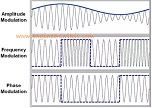
Phase Modulation (PM) is a modulation technique in which the phase of the carrier signal is varied in proportion to the instantaneous amplitude of the modulating signal. The modulating signal carries the information to be …
Frequency Modulation
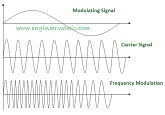
Frequency Modulation (FM) is a modulation technique in which the carrier signal’s frequency is varied in proportion to the instantaneous amplitude of the modulating signal. The modulating signal typically represents the information to be transmitted, …